
Tech guide · Turbos
Subaru Impreza turbos explained
Which turbo is on my car, and what is it good for? It is one of the most-read topics on the ISDC forum. This guide pulls together the club’s two long-running turbo threads and checks them against a UK tuner’s list of factory turbos, so you can identify yours, understand the differences, and know what an upgrade really involves.
At a glance
Read the tag
The turbo model is stamped on the compressor housing: VF for IHI, TD04 or TD05 for Mitsubishi.
Twin or single scroll
Twin-scroll VF36, VF37 and VF42 need the matching manifold and up-pipe.
Always remap
A bigger turbo needs fuel, supporting parts and a proper map.
Identify your turbo
- Read the tag on the compressor housing (the cold side). IHI turbos are stamped “VF” plus a number; Mitsubishi units are marked TD04 or TD05.
- Japanese-market WRX and STI models used IHI “VF” turbos.
- UK and European Impreza Turbo and WRX models mostly used a Mitsubishi TD04-family turbo, which is smaller and quicker to spool.
- Imported and modified cars are often swapped, so always check the tag rather than going by the model.
Factory IHI turbos on the Impreza
| Turbo | Fitted to | Scroll | Bearing | Character |
|---|---|---|---|---|
| VF22 | JDM classic WRX (Version III) | Single | Roller | Biggest compressor of the VF range: most top end, slowest to spool |
| VF23 | 22B STI; some classic STI (Version III–IV) | Single | Ball | Quicker to spool than the VF22, with less top end |
| VF24 | JDM classic STI (Version IV) | Single | – | Good low-down response; popular with Group N rally cars |
| VF28 | JDM classic STI (Version V) | Single | – | Similar size to the VF23 |
| VF29 | JDM classic STI (Version VI) | Single | – | A VF24 with a revised compressor wheel; usually preferred over the VF24 |
| VF30 | JDM New Age STI (early) | Single | Thrust | Often called the best value of the range: less lag than a VF22 |
| VF34 | JDM New Age STI Spec C (early) | Single | Ball or roller (sources differ) | Same compressor as the VF30, spools about 500 rpm sooner |
| VF37 | JDM Blobeye and Hawkeye STI | Twin | Thrust | A faster-spooling VF30 |
| VF36 | JDM Blobeye and Hawkeye STI Spec C / Type RA | Twin | Ball or roller (sources differ) | A faster-spooling VF34, with a lightweight titanium turbine |
| VF42 | JDM S203 and S204 | Twin | Roller | Larger compressor than the VF36/VF37; quicker spool and more top end |
| VF39 | US-market STI (2004–06) | Single | Thrust | Cheap and common second-hand; known for cracking around the wastegate hole |
| VF43 | US-market STI (2007) | Single | Thrust | A VF39 with a larger wastegate to reduce boost creep |
| VF48 | US-market STI (2008–10) | Single | Thrust | Not a direct bolt-on to earlier cars |
Where the club threads and the tuner’s list disagree on a detail, we have said so, or left it out. Power figures quoted online for these turbos are rough guides only: they depend on the engine, fuel, map and supporting parts.
Single-scroll or twin-scroll?
- Single-scroll (most classics and early New Age cars) is the simpler set-up, and most single-scroll VF turbos bolt on to each other’s cars with the right fittings.
- Twin-scroll (VF36, VF37, VF42 on 2003-on JDM STIs) keeps the exhaust pulses separate for faster spool. It needs the matching twin-scroll manifold and up-pipe, so it is not a simple swap onto a single-scroll car.
Upgrading: what else you need
- A proper remap, every time. More boost without more fuel is the classic way to melt a piston.
- Fuel: bigger injectors and a fuel pump are often needed with a bigger turbo.
- Supporting parts: intercooler, up-pipe or downpipe, and a clutch that can take the extra torque.
- Fuel quality: map for the fuel you actually use. Irish 95 RON is not Japanese 100 RON.
- NCT: decats and loud exhausts can fail emissions; see our NCT emissions guide.
Buying a used turbo
- Check for shaft play: a little side-to-side movement is normal on journal-bearing turbos; in-and-out play or the wheel touching the housing is not.
- Look for oil in the compressor housing and intercooler pipes, and blue smoke on the car it came from.
- Inspect the compressor wheel for chipped or bent blades.
- Check the turbine housing for cracks, especially around the wastegate hole.
- Ask what came with it: oil and water lines, gaskets and actuator.
Look after the one you have
- Warm the engine up gently before using boost.
- Let it idle for 30–60 seconds after a hard drive.
- Change the oil on time and keep it topped up.
- Signs of trouble: blue smoke on boost, a siren-like whine, oil in the intercooler, or boost that comes in slowly.
From the forum
This guide builds on two of the forum’s most-read threads: Turbos Explained (started by nic spec c, 2008) and VF Turbo range spec’s (started by scoobyke, 2008). Thanks to everyone who contributed. Add your own experience there.
More guides
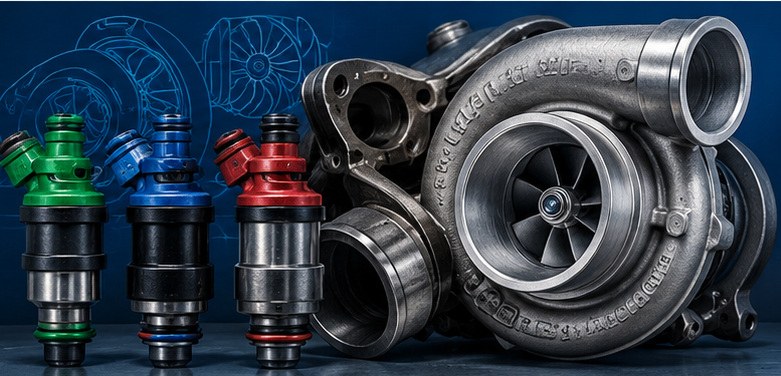
Impreza injectors and turbos explained
Gearboxes, diffs and DCCD
Subaru Impreza service guide
Got a question? Ask the club
Subaru owners have been sharing know-how on the ISDC forum since 2000. Post your question and someone will have been there before.